COUNTERING BIOLOGICAL WEAPONS DISINFORMATION
BWC Briefing Note | August 2026
Erosion of information integrity is a pressing concern for the BWC. Since 2022, false narratives alleging the misuse of biological laboratories in Ukraine and other partner countries have remained a persistent focus, while their geographic scope has broadened to regions including Africa, the Asia-Pacific and the Middle East. These narratives increasingly reflect regional specificities, circulate through proxy channels and multilingual media ecosystems, and frame peaceful bioscience cooperation as politically motivated, neocolonial or selectively enforced.
Left unchallenged, such claims can erode trust between States Parties, weaken confidence in transparency and cooperation measures, and complicate efforts to strengthen the Convention. The Global Partnership’s Counter WMD Disinformation Initiative supports efforts to identify, counter and build resilience against these narratives, helping to protect the integrity of the global norm against biological weapons.
NEW REPORT: THE MATRYOSHKA WAR
Biological disinformation has become part of the geopolitical contestation around global health security, in which laboratories, sample-sharing, genomic surveillance, outbreak response, cooperative threat reduction and technical assistance are reframed as threats. The foundational “biolab” narrative alleges that peaceful biological cooperation conceals covert military activity. Its ambiguity is central to its usefulness: it can be adapted to almost any laboratory, outbreak, foreign partner or biosurveillance programme, allowing very different local cases to be drawn into the same geopolitical storyworld.
The Matryoshka model explains how these narratives travel and gain force. At the multilateral layer, allegations enter formal settings such as the BWC as questions of compliance, transparency or verification, giving them procedural weight. At the state and media layer, technical-sounding claims are produced, translated and circulated through official, state-aligned and proxy channels. At the local layer, these claims connect with existing concerns about sovereignty, equity, foreign influence, military involvement or access to biological resources. Each layer reinforces the others: local anxieties are repackaged as international “evidence”, state actors cite them to validate the broader biolab narrative, and the narrative is then redeployed in new regional contexts. The result is a durable feedback loop that can distort assessments of compliance, weaponise public health cooperation and complicate efforts to sustain trust in the BWC.
NEW DEBUNKING BRIEF: EBOLA DISINFORMATION
As Ebola spreads in the Democratic Republic of the Congo and Uganda, familiar disinformation narratives have resurfaced, casting doubt on the disease’s origins and suggesting links to biological weapons. These claims are not new; they echo narratives seen during earlier outbreaks, including in West Africa in 2014, because they are familiar, adaptable and easily reactivated during periods of heightened concern. By fuelling fear, suspicion and confusion, they can exploit public attention to advance pre-existing strategic interests. This analysis highlights their reuse to expose recurring tactics and strengthen resilience against them.
Ebola disinformation often amplifies perceived risk by presenting mortality rates without context, exaggerating transmission, or suggesting weaponisation. This can heighten fear and make audiences more receptive to further manipulation, particularly where existing social divisions or institutional mistrust are already present.
Many narratives seek to foster doubt about outbreaks by urging audiences to “question more”, rely on speculative or false data, and adopt conspiratorial interpretations. Even without making explicit allegations, they can shift perceptions of Ebola from a natural outbreak to something potentially deliberate.
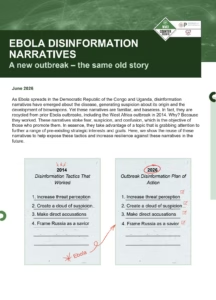 Some narratives go further, directly accusing adversaries of creating biological weapons. These claims can erode trust, exploit scepticism toward institutions such as “big pharma”, and draw on themes of colonialism, ethnic tension and past crises. Other narratives position Russia as a responsible global actor by emphasising its vaccines and aid, contrasting this with depictions of US involvement as suspicious, inadequate or neocolonial.
The reuse of disinformation from past Ebola outbreaks is expected and revealing. As the current outbreak continues, similar tactics may reappear, including claims about ethnic weapons, biolabs and conspiracy-framed research. Recognising these patterns can help policymakers, communicators and the public identify and resist manipulation more effectively.
ENGAGE WITH US TO FURTHER YOUR UNDERSTANDING
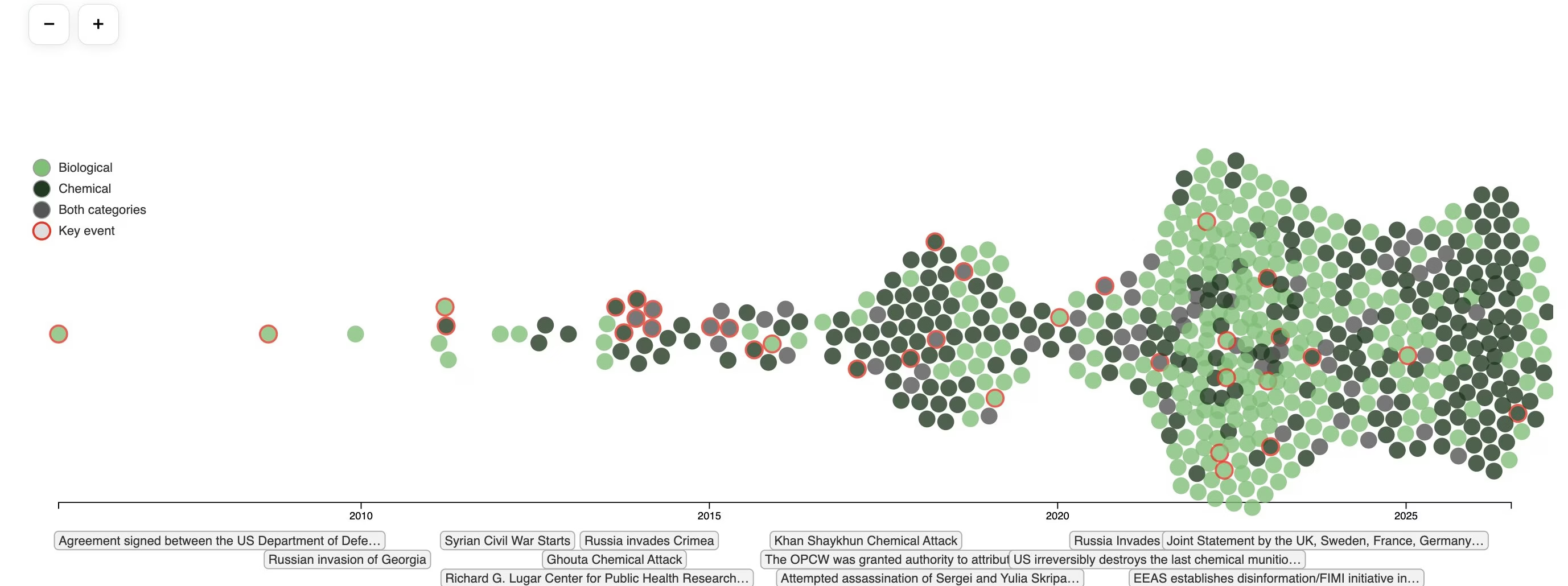
Maintaining situational awareness of disinformation is now an important part of effective BWC participation. False allegations and politicised narratives often circulate in parallel information spaces before entering formal multilateral settings. Tracking these trends helps States Parties anticipate narrative escalation, distinguish genuine compliance concerns from coordinated disinformation, and avoid reactive dynamics that can further erode trust.
Regular monitoring of biological weapons and global health security disinformation should therefore be treated as a practical risk-reduction measure, supporting evidence-based engagement and protecting the technical integrity of the Convention. States Parties can use the CBRN disinformation tracker, roadmaps, tactic spotlights and other resources to stay informed about emerging CBRN narratives affecting disarmament diplomacy.
RESPONDING TO DISINFORMATION IN THE CONFERENCE ROOM
Possible language to counter biolab disinformation narratives:
The biological facilities in question are engaged in purely peaceful activities, including biosurveillance and the development of medical countermeasures.
The financial and technical assistance provided to these facilities, which is fully and publicly documented, falls squarely under Article X of the Convention and is aimed at reducing biological threats, including the threat posed by biological weapons.
These allegations are not only false, but also dangerous, as they undermine international cooperation and assistance and can erode confidence in Convention.
Possible language to counter biolab disinformation narratives expanding to Africa and other regions:
The false claims about biological activities in [insert country] are nothing more than a new spin on decades-long disinformation campaigns against peaceful cooperative threat reduction activities.
These activities are essential for understanding and mitigating biological threats in the region and attempts to delegitimize them aim to undermine international security and compromise global health security writ large.
Possible language to counter suggestions of secrecy or neglect in reporting ICA:
The Russian Federation has continuously sought to undermine international cooperation and assistance under Article X by falsely claiming that States Parties are using cooperative threat reduction programmes as a cover for offensive activities in violation of the BWC.
At the same time, the Russian Federation has also sought to undermine efforts to enhance transparency and build trust by falsely alleging that some states are leaving important details out of their reporting requirements.
This is untrue, as states parties regularly report transparently on their ICA activities through working papers, national statements and publicly available reports, presentations and brochures. Many of these reports are available on the UNODA website.
Members of the G7-led Global Partnership also share details of their biosecurity capacity-building efforts through an annual programming annexe. We see no need to duplicate reporting on these activities by including them in CBM forms and refuse to further the false narrative that certain states are withholding information.