
The Matryoshka War Report
Key Findings and Implications
August 2026
FALSE ALLEGATIONS
Biological disinformation is no longer a marginal phenomenon or simply a collection of online rumours. The Matryoshka War report shows how it has become embedded in wider geopolitical contestation around global health security, biological cooperation and arms control.
At the centre is the persistent “biolabs” narrative: the claim that foreign-supported biosecurity and public-health cooperation—particularly involving the United States and other Global Partnership states—conceals covert military-biological activity. Since the mid-2010s, and particularly following Russia’s full-scale invasion of Ukraine in 2022, this narrative has been systematically promoted by Russian state institutions and aligned actors, and extended far beyond Ukraine.
“These are not isolated conspiracies. They are regional expressions of a single GLOBAL NARRATIVE of biological disinformation.”
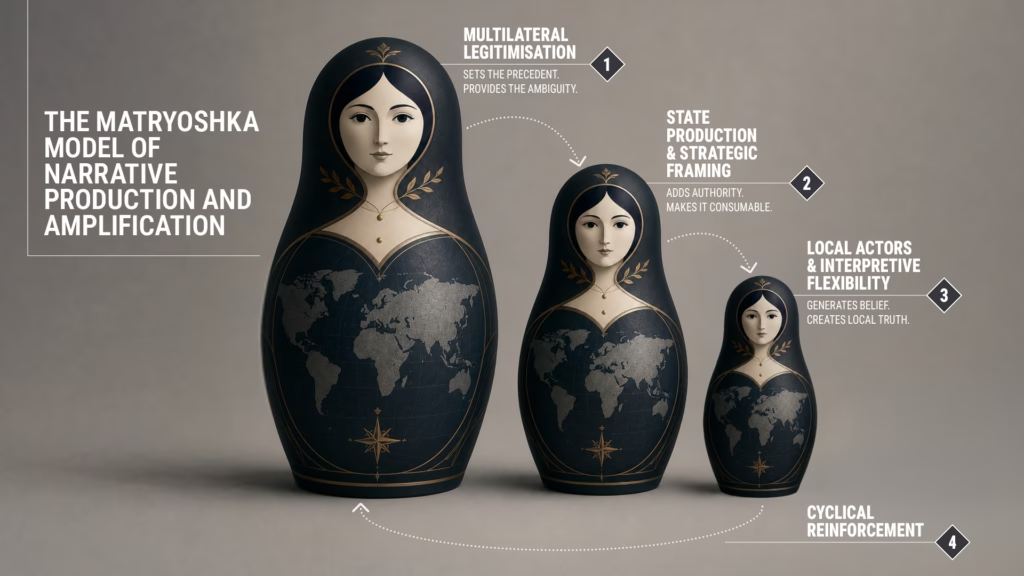
The report traces its manifestation across Africa, Southeast Asia and Latin America,
drawing on fieldwork, interviews and focus groups alongside analysis of social media, state-linked media and other open-source material.
Despite major differences between the regions, laboratories, outbreaks and routine health-security activities have repeatedly been incorporated into the same overarching narrative.
What the REGIONAL CASES REVEAL…
Africa: Outbreak trauma, colonial memory, medical mistrust and concerns about unequal scientific partnerships give allegations emotional resonance. Ebola and other disease emergencies have provided particularly powerful material for narratives of experimentation, exploitation and external control.
Southeast Asia: Concerns over dual-use science, foreign military involvement, pathogen and sample sharing, food security and national sovereignty can make routine biosurveillance and laboratory cooperation appear strategically ambiguous.
Latin America: Histories of foreign intervention, anti-imperialist political narratives, border insecurity and distrust of external actors provide a durable political framework through which laboratories and outbreaks can be reinterpreted.

The critical finding is that these narratives succeed not simply because audiences reject science, but because science and health infrastructure increasingly sit within geopolitical competition. Laboratories, genomes, pathogens and surveillance systems can therefore become symbols of sovereignty, foreign influence and strategic rivalry.
Implications for policy and practice
Effective responses need to address the architecture of disinformation, not simply rebut individual false claims. This means:
- Identifying where genuine local grievances can be captured and amplified;
- Anticipating which laboratories, partnerships and outbreaks are vulnerable to manipulation; and
- Strengthening transparency, equity and local ownership in international biological cooperation.
It also requires stronger resilience across labs, health ministries, scientific partnerships, regional networks and treaty institutions, alongside systematic monitoring of emerging disinformation hotspots.
“Information integrity is now part of biological disarmament. Not an add-on. Not a communications issue. It is part of the security environment itself.”
Why this matters
The consequences extend well beyond the information environment:
- Arms control can itself become an information battlespace. Repeated allegations introduced through the BWC and other multilateral mechanisms can acquire procedural legitimacy and undermine confidence in compliance processes.
- Public health is weaponised politically. Biosurveillance, outbreak response, laboratory strengthening and international scientific cooperation can be reframed as evidence of hostile intent.
- International cooperation becomes vulnerable. Governments and institutions can be placed in a damaging bind: defending cooperation may be portrayed as evidence of complicity, while disengagement can weaken real health-security capacity.