
Alexey Rtishchev’s December 2025 Briefing Debunked
On December 12, 2025, Major General Alexey Rtishchev, Deputy Chief of Russia’s Radiation, Chemical, and Biological Protection Troops gave a briefing that contained numerous false allegations pertaining to biological, chemical, and radiological weapons. The Global Partnership’s Counter WMD Disinformation Initiative has systematically debunked a selection of allegations in the briefing while also drawing attention to the broader tactics used in such campaigns. By learning to recognize these tactics, the global nonproliferation and disarmament community can build resilience to CBRN disinformation, safeguarding vital multilateral agreements and norms.
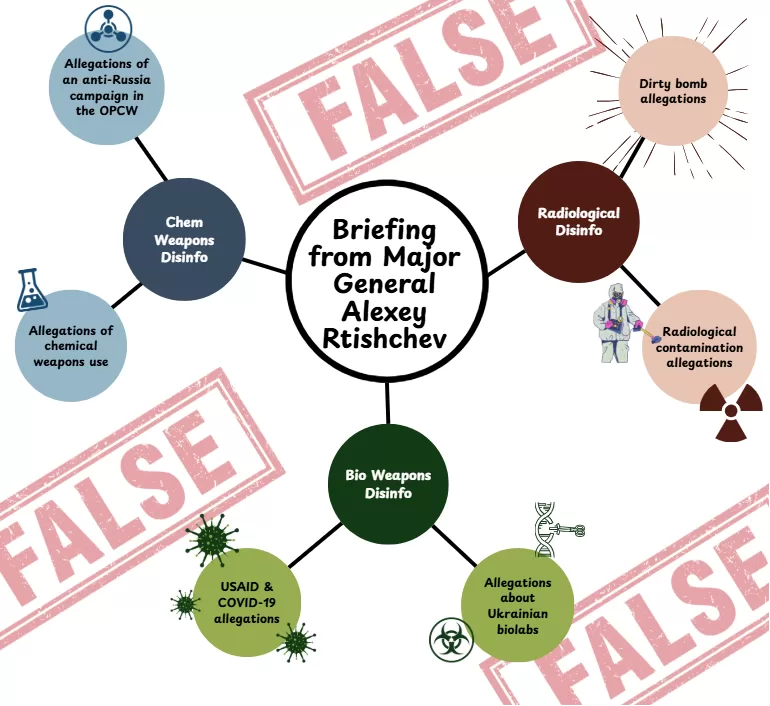
For more information about the tactics frequently used in CBRN disinformation campaigns, view our Tactic Spotlights and Disinformation Roadmaps.
Biological Weapons Disinformation: USAID and COVID-19 Allegations
In the briefing, Rtishchev falsely claims that to disguise its nefarious biological activities, the U.S. government conducts its “illicit” research through civilian agencies such as USAID. He further claims that USAID funded Event 201, a pandemic preparedness exercise that took place before the COVID-19 pandemic. Taken together, these allegations represent a thinly veiled attempt to blame the COVID-19 pandemic on the U.S. government. The posts and photos below, which are used to support Rtishchev’s claims, contain several common disinformation tactics.
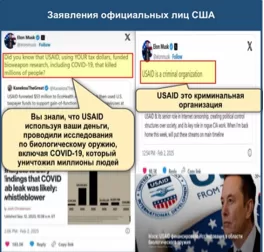
Disinformation Tactic: Appeal to Emotions
This statement, which is translated into Russian in the speech bubble below, is factually inaccurate and deliberately inflammatory. It is designed to arouse anger and disgust at the U.S. government’s purported misuse of taxpayer dollars. Such emotions can cloud rational thinking and impair judgement, making it difficult for audiences to think critically about what they are reading or hearing. There is no evidence to suggest that USAID ever funded bioweapons research.
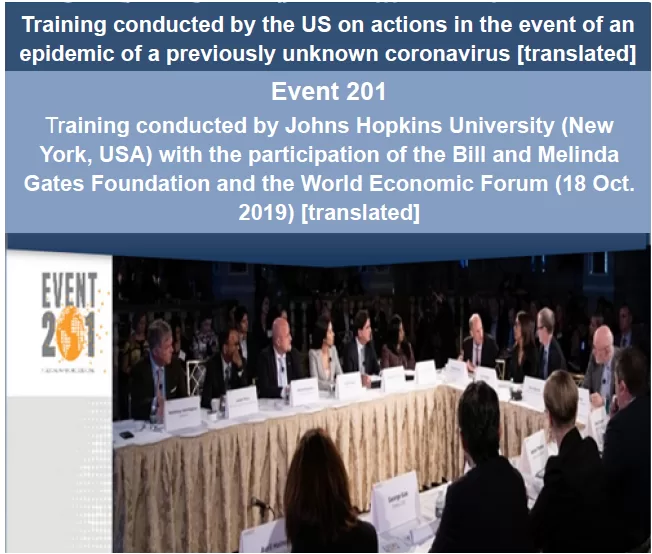
Disinformation Tactic: Provision of “Evidence”
Event 201 was an exercise conducted by Johns Hopkins University to help governments and the private sector prepare for pandemics. Rtishchev uses the event to falsely show that there is “evidence” of USAID’s purported wrongdoing. However, the exercise was not funded by USAID and had nothing to do with biological weapons. On the contrary, the exercise scenario centered on a natural spillover event. Moreover, the fact that a coronavirus was used reflects the reality that coronaviruses have long caused natural outbreaks. The event organizers even acknowledge that it was based loosely on SARS (a disease caused by a coronavirus, but not the same coronavirus that causes COVID-19). The event does not suggest, in other words, that anyone knew about COVID-19 before it occurred.
Biological Weapons Disinformation: Allegations about Biolaboratories in Ukraine
The briefing also repeats the familiar “biolabs” disinformation narrative, claiming that the U.S. government was using Ukraine as a testing ground for dangerous and illegal biological experiments. Rtishchev claims that such activities have been confirmed by statements from U.S. government officials and scientists. The statements he references, however, are either deliberately misinterpreted or made by individuals with irrelevant or dubious qualifications. This is a common tactic designed to make false claims appear more legitimate or trustworthy.
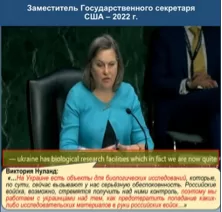
Translation: “Ukraine has biological research facilities, which, in fact, we are now quite concerned Russian forces may be seeking to gain control of, so we are working with the Ukrainians on how they can prevent any of those research materials from falling into the hands of Russian forces”
Disinformation Tactic: Referencing Authoritative Sources
In this quote, Victoria Nuland expresses concern that Russian forces could gain control of research facilities in Ukraine – a concern that was warranted given that even peaceful research facilities contain pathogens that could be used to cause harm. In the briefing, however, her statement is deliberately misinterpreted as an admission by the U.S. government that it was conducting biological weapons research in Ukraine – an admission that Victoria Nuland never made. The underlying tactic is effective both because the quote is accurate (even though it was taken out of context) and because Victoria Nuland is considered an authoritative (i.e., trustworthy) source.
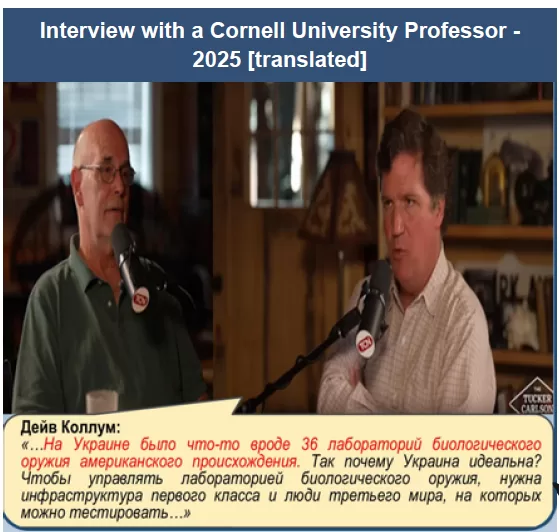
Translation: “There were something like 36 bioweapons labs in Ukraine of U.S. origin. So, why is Ukraine perfect? Ukraine’s perfect. To run a bioweapons lab, you need first-world infrastructure and third-world people to test on.”
Disinformation Tactic: Referencing Authoritative Sources
In this quote, a professor named Dave Collum makes the false claim that there were 36 biological weapons laboratories run by the US in Ukraine. While Dave Collum is a professor, his specialty is in organic chemistry. He has no relevant qualifications in biological weapons or public health, making him unqualified to comment on U.S. cooperative biological activities in Ukraine. His title as a professor, however, is being used strategically because it suggests he is an authoritative source.
Dave Collum’s false statement about the US conducting medical experiments on “third-world people” is also a strong appeal to emotions. This is another tactic that is regularly used to spread disinformation. This statement is manipulative and designed to play on fears of exploitation – a strategy that may be particularly effective among communities that have been exploited in the past.
Radiological Weapons Disinformation: Dirty Bomb Allegations
The briefing frames Ukraine’s radiation safety activities as a serious threat and alleges that Kyiv is engaging in “nuclear blackmail.” It provides no definition of the term and offers no evidence of a coercive threat linked to any concrete political demand. Instead, the allegation mirrors longstanding criticism of Russia’s own nuclear signaling since 2022, creating a false equivalence and shifting perceived responsibility through a fabricated “dirty bomb” narrative. Taken together, these claims use vague, high-impact language to discredit Ukraine and undermine international support.
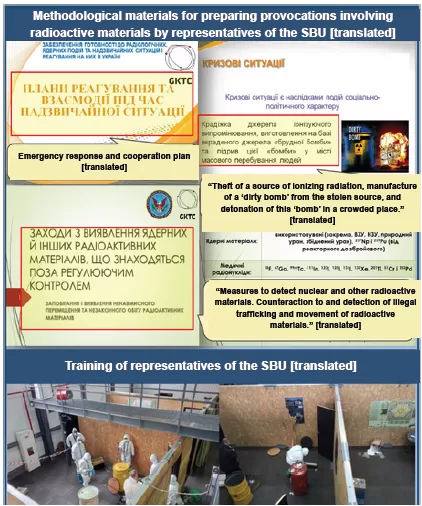
Disinformation Tactic: Provision of “Evidence”
The briefing begins by accusing Ukrainian officials of covertly importing spent nuclear fuel for a “dirty bomb,” but no evidence supports the allegation.
It goes on to claim that SBU training simulates the theft of ionizing radiation sources, the construction of a “dirty bomb,” and its detonation in a crowded area. These exercises, presented alongside images of personnel in protective suits, are used as “evidence” that Ukraine intends to conduct such an attack. In practice, such scenarios are part of standard CBRN counterterrorism training used internationally to strengthen preparedness and response to recognized threats, including terrorist acquisition and use of radioactive sources. The SBU is legally mandated to conduct counterterrorism and state security preparedness, including for radiological threats. The briefing materials therefore function as pseudo-evidence by reframing legitimate security training as incriminating proof of malintent.
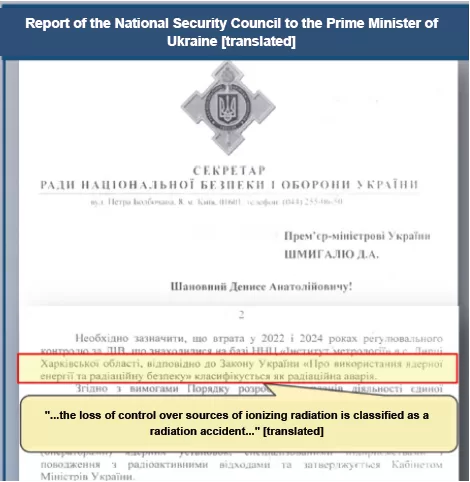
Disinformation Tactic: Provision of “Evidence”
Russia’s briefing asserts that Ukraine lost control of 68 ionizing radiation sources in the Kharkiv region and uses this to suggest that Kyiv could build a “dirty bomb.” The allegation relies on the selective quotation of Ukrainian documentation that describes a “loss of control.” In regulatory practice, such reporting is mandatory when sources cannot be physically verified, including due to war-related access restrictions (which is what occurred in this case due to Russia’s invasion and subsequent military operations). Ukraine’s documentation therefore reflects compliance with safety and security obligations and alignment with IAEA expectations rather than an admission of illicit activity. The materials function as pseudo-evidence by reframing mandatory incident reporting as evidence of Ukrainian malintent.
Radiological Weapons Disinformation: Radiological Contamination Allegations
The briefing also claims that Western military and financial assistance “provokes” violations of nuclear material handling norms in Ukraine, further asserting that the “degradation” of the state administration could push Ukraine and parts of Europe towards an environmental catastrophe. It offers no credible causal pathway linking external assistance to any compliance failures and provides no evidence of any concrete incident. No public IAEA finding supports these allegations.
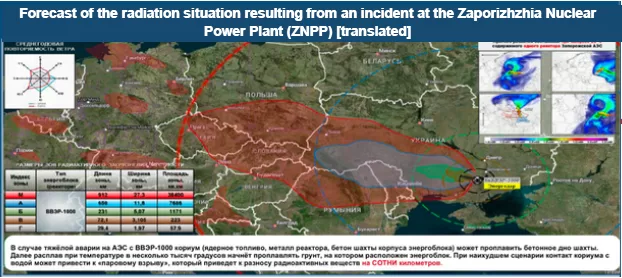
Disinformation Tactics: Cherry Picking, Fear Mongering
The briefing asserts that a radiation accident occurring at the ZNPP would result in a Chornobyl-like fallout, with radiation spreading across Ukraine and Europe. This allegation weaponizes selective radiological modeling and historical trauma. The referenced “forecast” is cherry-picked from standard multi-scenario emergency planning, which uses dynamic tools like JRODOS or FLEXPART to simulate multiple plume trajectories depending on variable weather. Moreover, equating current risks at the ZNPP to Chornobyl is scientifically flawed: unlike the 1986 core meltdown, explosion, and high-energy graphite fire, which lofted radioactive material into the stratosphere, any localized incident at the ZNPP would lack the thermal energy necessary for long-range atmospheric transport, especially while the ZNPP is in cold shutdown. Hence, the claim relies on unsubstantiated fear mongering by invoking the collective trauma of the Chornobyl disaster.
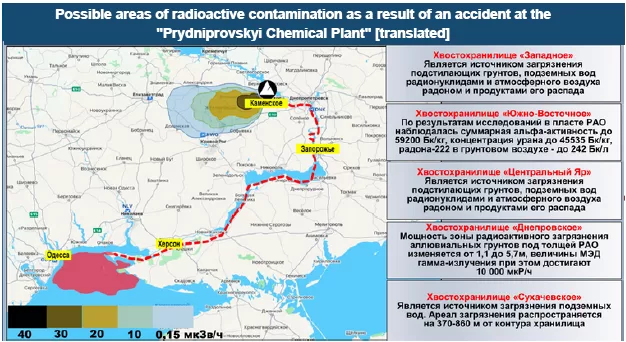
Disinformation Tactics: Provision of “Evidence”, Fear Mongering, Discrediting Opponents
In the briefing, a uranium legacy site in Kamianske is presented as an urgent radiological threat. The briefing claims that the Prydniprovskyi Chemical Plant poses dangerous contamination risks for the Dnipro basin and the Black Sea. The plant is indeed a Soviet-era uranium processing complex with long-term remediation needs. However, these are longstanding environmental and industrial safety challenges common for Soviet legacy sites and exacerbated by Russia’s invasion. The briefing repackages these issues as “evidence” of an acute crisis. Available assessments report the issue as a manageable engineering and remediation task rather than an acute catastrophe scenario. The briefing uses fear mongering to stoke concerns about a radiological emergency, portraying Ukraine as reckless and irresponsible with radioactive material in an attempt to discredit Russia’s opponent.
Chemical Weapons Disinformation: Allegations of an Aggressive Anti-Russia Campaign in the OPCW
In the briefing, Rtishchev makes several allegations to call into question the independence and neutrality of the OPCW. In particular, the briefing falsely claims that the OPCW is engaged in an aggressive, politically motivated campaign directed against the Russian Federation. These allegations seek to portray the OCPW as a Western-directed organization rather than an independent verification body. These narratives are designed to undermine confidence in the multilateral disarmament system and weaken trust in the Chemical Weapons Convention.
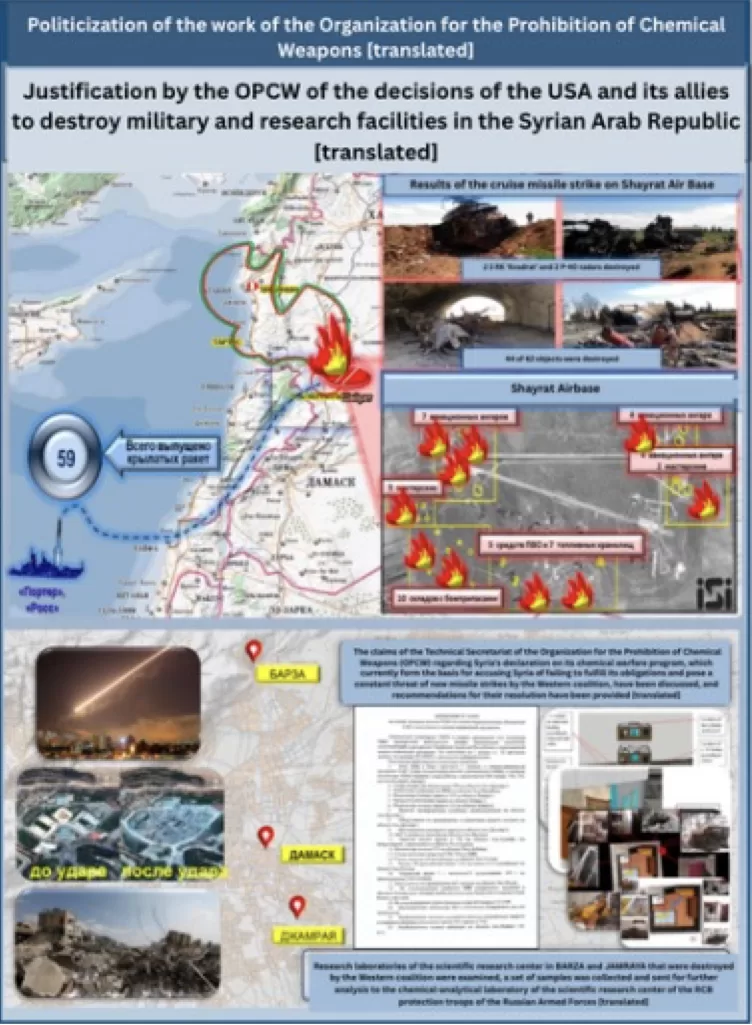
Disinformation Tactic: Discrediting the OPCW
This content seeks to connect actions and decisions made in the Syrian Arab Republic to ongoing activities in Ukraine. This image displays Rtishchev’s claims that the OPCW is a puppet of the West and falsely frames investigations and decisions by the OPCW as justifications for Western military actions. Through such claims, Russia seeks to erode trust in the multilateral verification mechanisms of the OPCW, allowing Russian officials to dismiss any findings that contradict their allegations as politically motivated rather than evidence based. These narratives serve to weaken both the OPCW and the Chemical Weapons Convention.
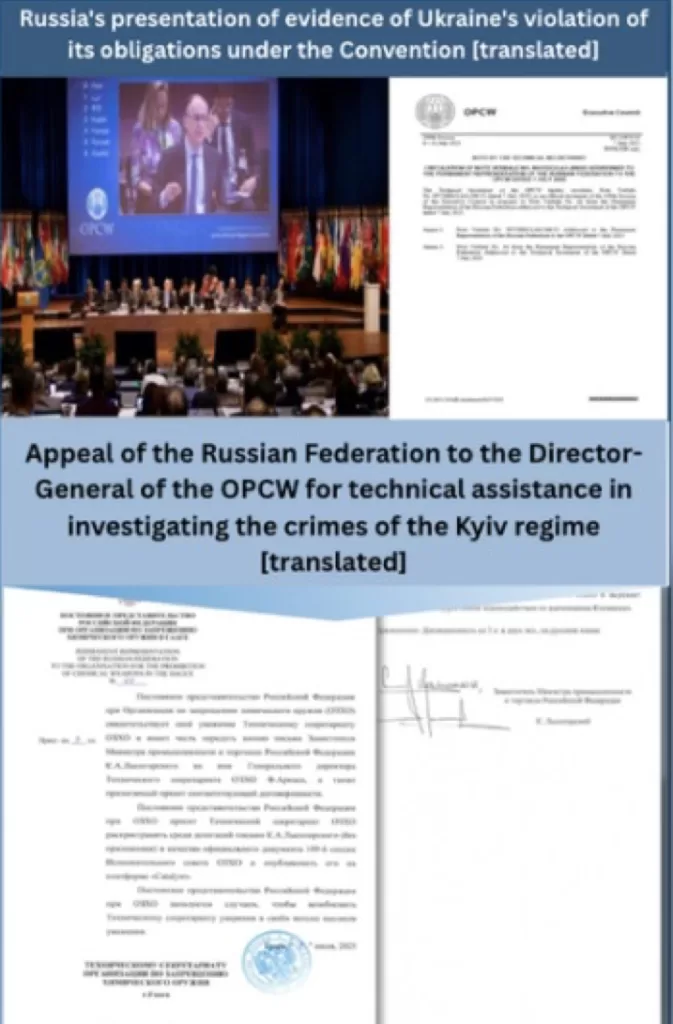
Disinformation Tactic: Portraying States and Organizations as Puppets
Rtishchev claims the Russian Federation regularly informs the OPCW about instances of chemical weapons use by Ukrainian forces and provides “evidence” for these claims. Examples include numerous Notes Verbales Russia has submitted to the OPCW, such as the one pictured in this example from July 2025. This statement is deliberately misleading, as the claims outlined in these Notes Verbales regularly include disinformation, unfounded accusations, and misleading or unsubstantiated “evidence” (another common disinformation tactic used in this briefing).
In this briefing, Rtishchev specifically claims Western states “control the OPCW,” stripping neutrality and independence from the Organization. This tactic weakens the verification mechanisms in place and suggests international organizations cannot act independently or transparently.
Chemical Weapons Disinformation: False Allegations of CW Use
The briefing included multiple claims of chemical weapons use by Ukrainian forces and its allies. One example was a claim that the Russian Ministry of Defense uncovered more than 600 instances of chemical weapons use by the Ukrainian Armed Forces, including the use of riot control agents and scheduled chemicals. To support his claims, Rtishchev provides several pieces of “evidence.” This is a common tactic used throughout the briefing to support unfounded claims. While such evidence has the appearance of legitimacy and even scientific robustness, it either lacks independent third-party verification or represents a deliberate misinterpretation of information.
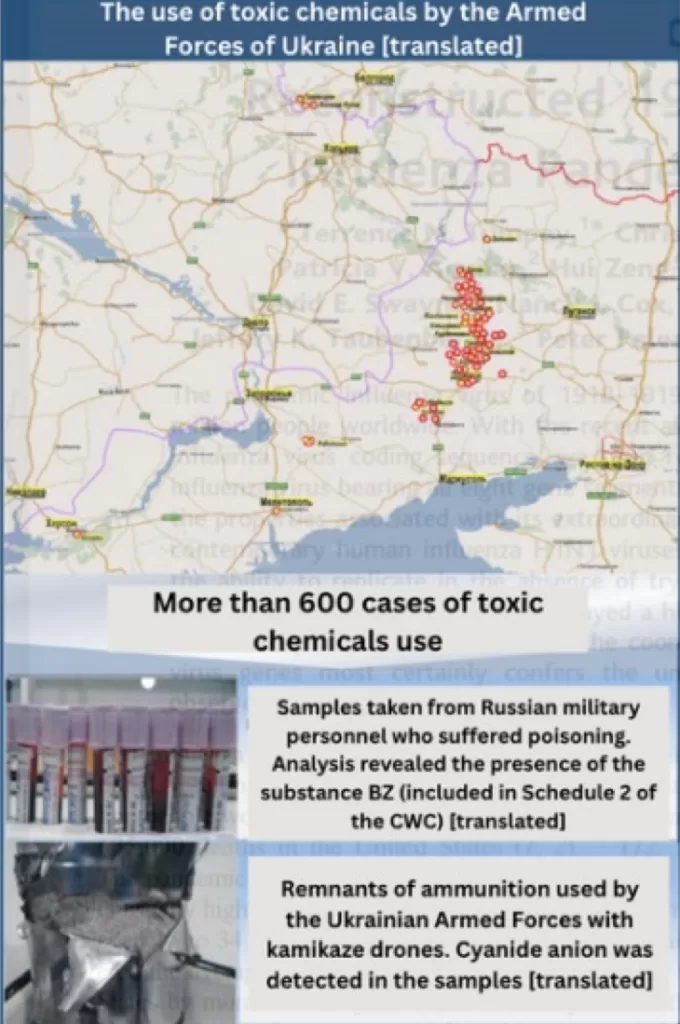
Disinformation Tactic: Provision of “Evidence”
In this image, a map is presented that purportedly shows cases of chemical weapons use by the Armed Forces of Ukraine. Without independent investigation of each individual case, including soil sample collection, eyewitness testimony, and other critical pieces of information, the map cannot be considered a legitimate form of evidence. Below the map, images of blood samples purportedly taken from poisoned Russian military personnel are presented, along with a photo of ammunition that is said to contain cyanide. Like the map, such photos are inherently misleading, as they lack any independent analysis or verification. Additionally, no information is provided about the methods used to detect the alleged substances, which is problematic given the difficulties and nuances associated with the detection of chemical weapons. Most intact chemical warfare agents, for example, including BZ, cannot be detected in blood after certain periods because they are metabolized and/or eliminated rapidly. While methods for detecting metabolites or other markers are available, no methods are specified in the photo.
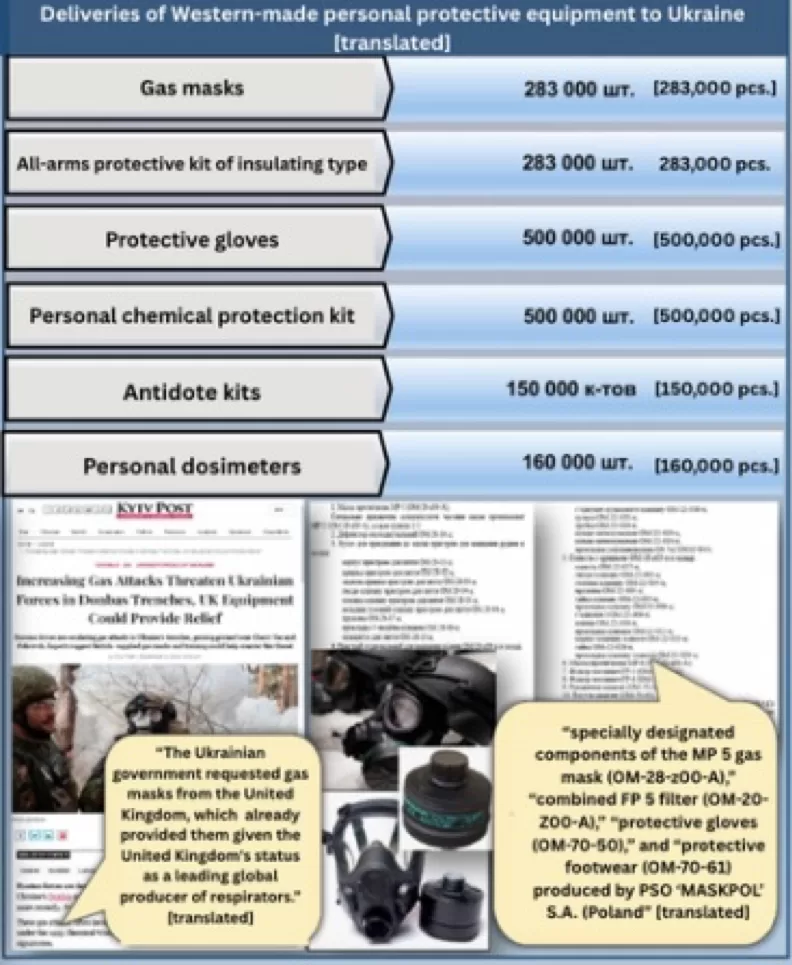
Disinformation Tactic: Provision of “Evidence”
Rtishchev also claims that deliveries to Ukraine of personal protective equipment (PPE) and antidote kits prove Ukraine’s use of (or intent to use) chemical weapons. Framing CBRN preparedness measures as evidence of malintent is a common tactic used by the Russian government to support false claims for which there is no substantive evidence. As the article included in the image suggests, such equipment was requested to protect Ukrainian forces from Russian chemical attacks.