COUNTERING CHEMICAL WEAPONS DISINFORMATION
OPCW CSP-30 BRIEFING NOTE | NOVEMBER 2025
The Chemical Weapons Convention (CWC) continues to be a forum in which state-sponsored disinformation is spread, including during and leading up to Conferences of States Parties. False allegations erode trust in the Organisation for the Prohibition of Chemical Weapons (OPCW) and weaken the broader nonproliferation, arms control, and disarmament (NACD) regime. The Global Partnership Against the Spread of Weapons and Materials of Mass Destruction’s (GP) Counter WMD Disinformation Initiative seeks to build resilience to these false allegations and uphold trust in multilateral institutions, notably the OPCW.
FALSE ALLEGATIONS
In the context of their invasion of Ukraine, Russia has submitted multiple Note Verbales (NVs) alleging that Ukraine has or intends to use chemical weapons. This includes a recent Note Verbale submitted by the Russian Federation to the Technical Secretariat of the OPCW ahead of the 110th session of the Executive Council and the 30th Conference of the States Parties.1
In this NV, Russia claimed—without verifiable evidence—that test tubes it allegedly discovered in the Donetsk region contained toxic chemicals (including chloropicrin) that Ukrainian forces intended to use against Russian forces. In addition, Russia indicated that this NV was submitted to provide more context to its request for technical assistance from the OPCW Technical Secretariat. This is the first time Russia has requested technical assistance in the context of its invasion of Ukraine and may signal its intentions to use OPCW technical assistance mechanisms to bolster its allegations. The GP Counter WMD Disinformation Initiative is actively monitoring this development.
COMMON DISINFORMATION TACTICS TO BE ON THE LOOKOUT FOR
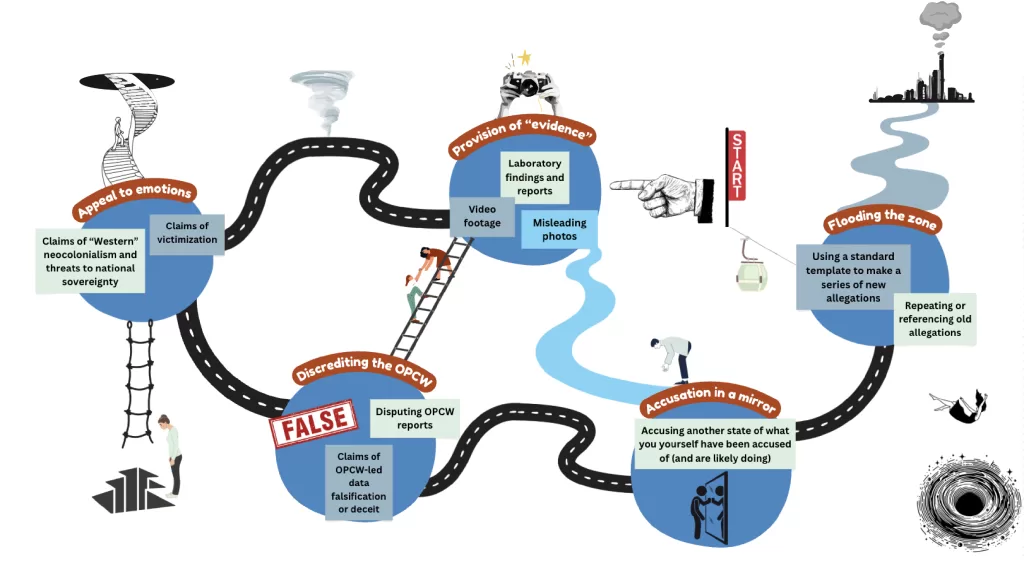
Our analysis of NVs revealed the frequent recycling of 5 common tactics across CW-related disinformation campaigns. These are displayed in the figure below.
COUNTERING TACTICS USED IN THE MOST RECENT NOTE VERBALE
In its most recent NV, Russia used three of its most common tactics:
- Provision of “evidence”: The NV includes photos of barrels, plastic containers, and test tubes. However, the mere presence of these materials does not constitute evidence of chemical weapons activity and cannot be verified.
- Potential refutation language: “The images presented in the NV depict common equipment readily available in most settings. In addition, neither the images themselves nor the contents of the equipment depicted in the images have been vetted or verified by the OPCW. As such, they cannot be treated as definitive or reliable evidence.”
- Fake mirroring: In 2024, Ukraine requested a Technical Assistance Visit (TAV) following an incident on the battlefield. In some of the samples provided by Ukraine, OPCW-designated laboratories detected the presence of a riot control agent. As such, Russia’s current allegations may be designed to distract and deflect from its own use (or planned use) of chemical weapons in Ukraine.
- Potential refutation language: “We must not let Russia’s most recent allegations distract us from our discussions today or the fact that it may have used chemical weapons against Ukrainian forces. These allegations are being used with insufficient evidence to substantiate the claims. They are a potential smokescreen for Russia’s own violations of the Convention.”
- Appeal to emotions: The NV references Germany’s use of chloropicrin during World War I. This reference is designed to arouse feelings of fear and anger and link nefarious actions of the past to the claims in this note verbale. Historical crises are commonly used as emotional trigger points in disinformation campaigns, encouraging audiences incorrectly to link past atrocities with current events in their minds.
- Potential refutation language: “The reference to Germany’s use of chloropicrin during World War I is disingenuous and designed to trigger strong negative emotions. These emotions can cloud judgement and impair rational thinking. We should question why such manipulative language and content is being used.”
ACTIONS TO COUNTER DISINFORMATION
There are several actions diplomats can take to identify and counter disinformation about chemical weapons, including:
- Raise awareness of the common disinformation tactics described above. The more others are able to recognize these tactics in official statements, NVs, and other documents, the more resilient the diplomatic community can become to information manipulation in all its forms.
- Voice support for the OPCW, including OPCW inspection and assistance mechanisms. Purveyors of disinformation seek to undermine confidence in the OPCW. By reaffirming support for—and trust in—the OPCW, states can protect this vital multilateral organization and ensure it can continue to fulfill its mandate.
- Debunk false claims as they arise. Some false allegations, particularly those that gain traction or raise alarm for other states, should be thoroughly refuted (i.e., debunked). However, it is important to debunk using evidence-based practices. Additional guidance about this process can be found in resources such as the Debunking Handbook.2
REFERENCES
Russian Federation. Note Verbale No. 67 from the Permanent Representation of the Russian Federation to the Technical Secretariat of the OPCW. Dated 30 September 2025. Accessed November 10, 2025.
Stephan Lewandowsky et al. (2020). The Debunking Handbook 2020.