DISINFORMATION TACTIC SPOTLIGHT
MASTER NARRATIVES
The Global Partnership Against the Spread of Weapons and Materials of Mass Destruction (GP) seeks to understand and counter Russian state-sponsored or state-adjacent disinformation across Chemical, Biological, Radiological, and Nuclear (CBRN) threats, in support of GP Member efforts. As part of this effort, the Johns Hopkins Center for Health Security (JHCHS) systematically analyzed over 300 news media items from the EUvsDisinfo Database to identify common narratives, tactics, and themes associated with pro-Kremlin CBRN disinformation.
Master narratives: Analysis of news media items in the sample revealed three master narratives – higher-level narratives that are used to shape world views in ways that benefit the Kremlin. Russia uses these narratives to contextualize its lower-level narratives and specific false claims, enhancing the overall effectiveness of its disinformation campaigns. Given the important role that master narratives play in disinformation campaigns, policy makers should incorporate an understanding of them into counter-disinformation materials, including debunking and prebunking materials, thereby ensuring greater resilience to Russian information manipulation.
OVERVIEW
MASTER NARRATIVES
What are master narratives?
Master narratives can be thought of as the higher-level stories that give meaning to lower-level narratives and specific false claims.1, 2 The Russian government and its associated proxy outlets use master narratives to contextualize their false claims, ensuring that they a) resonate with target audiences and b) are interpreted in ways that furthers the Kremlin’s interests. Russia’s master narratives, in other words, reflect the ways in which the Kremlin wants its target audiences to perceive the world around them.
How do master narratives fit into the broader CBRN disinformation space?
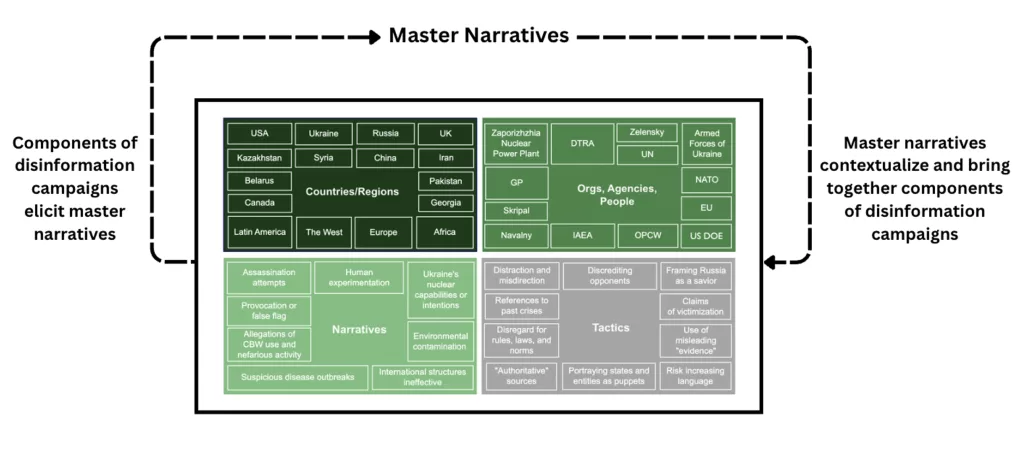
The relationship between master narratives and the other components of a CBRN disinformation campaign can be described as circular and mutually reinforcing. Master narratives give meaning and context to the lower-level components of a disinformation campaign, but those components are also chosen strategically to evoke and lend support to Russia’s master narratives. This relationship is depicted in the figure below.
EXAMPLES
Master Narrative: West Versus the Rest
This master narrative constructed an ongoing, existential conflict between the collective “West” and the rest of the world. Within this master narrative, the West’s purported pursuit (or use) of CBRN weapons was framed as a manifestation of its aggressive, neocolonial agenda, one that was aimed at exploiting and exerting control over non-Western countries, including Russia and Ukraine. In addition, this master narrative framed multilateral nonproliferation and arms control mechanisms as instruments of Western oppression, allowing Western nations to evade punishment for breaches of international law or falsely accuse others (particularly Russia) of WMD use.
Examples of claims that evoked this master narrative included:
- Claims that the United States places biolaboratories in foreign countries to exert control over disease outbreaks, allowing it to “create” epidemics and facilitate subsequent dependence on U.S./Western-produced diagnostics or therapeutics (tactic: discredit opponents).
- Claims that “Western” countries refused to cooperate following the poisoning of Aleskey Navalny and that the Organization for the Prohibition of Chemical Weapons (OPCW) is no longer an impartial or independent organization given the results of its investigation (narratives: assassination attempts, international structures ineffective).
- Claims that the “accumulation” of cruise missiles in NATO countries is not a defensive measure but one designed to facilitate aggression against non-NATO countries (tactics: discredit opponents, claims of victimization).
Example: “In conditions of elusive hegemony, the global West, represented by the United States, does not disdain any means to maintain its leadership. Washington relies on destructive methods aimed at weakening those who do not want to put up with American dictates. Placing biological laboratories in foreign countries is part of the U.S. strategy.” (Baltnews, 2022)
Master Narrative: Russia as a Responsible International Actor and the Guarantor of a Multipolar World Order
In this master narrative, Russia was framed as a responsible and even beneficent global actor, one that was committed to establishing a safer, more balanced (as opposed to Western-dominated) world order. Within this narrative, attention was drawn to Russia’s efforts to “protect” vulnerable communities (particularly those in Ukraine) from the proliferation or use of CBRN weapons. Russia’s apparent efforts to strengthen nonproliferation and arms control mechanisms were also emphasized, along with its efforts to hold the “West” accountable for its alleged violations of such mechanisms.
Examples of claims that evoked this master narrative included:
- Claims that Russia invaded Ukraine to stop or otherwise prevent Ukrainians from being experimented on in U.S.-funded biological weapons laboratories (narrative: human experimentation; tactic: framing Russia as a savior).
- Claims that Russia is carefully documenting and submitting “evidence” to the OPCW of the United States’ and Ukraine’s alleged use of chemical weapons to hold them accountable for their alleged “war crimes” (narrative: allegations of CW use; tactic: use of misleading “evidence”).
- Claims that Russia’s deployment of tactical nuclear weapons on Belarusian territory was a reasonable and commensurate response to the West’s “aggressive” nuclear policy, one that would ensure a more balanced and secure world (tactic: framing Russia as a savior, claims of victimization).
Example: “The deployment of Russian nuclear weapons on the territory of the Republic of Belarus is an adequate and restrained response of the Union State to the aggressive policy of the West. … Belarus and Russia are changing the rules in favor of a multipolar world order, equal and indivisible security for the vast majority—89 percent of humanity, which does not belong to NATO countries.” (Sputnik Armenia, 2023)
Master Narrative: Question More
This master narrative, which derives its name from slogan of the Russian state-sponsored news outlet RT, was designed to evoke suspicion and doubt among Russia’s target audiences, leading them to question the activities and statements of the United States, Ukraine, and other Western or Western-aligned countries. Within this master narrative, “clues” and various forms of “evidence” were provided to indicate to readers that the United States and/or Ukraine were lying about their CBRN-related activities or were attempting to obfuscate their true intentions regarding their pursuit of WMD. Examples of claims that evoked this master narrative included:
- Claims that there are “suspicious” disease outbreaks occurring near U.S.-funded biolaboratories, casting doubt on the U.S. government’s assertions that such laboratories are engaged in peaceful activities (narrative: suspicious disease outbreaks).
- Claims that the British government made up a fake general to blame for the Salisbury poisonings to cover up the nefarious activities taking place at Porton Down (narrative: assassination attempts).
- Claims that while Western audiences have been led to believe that Russia poses a nuclear threat, Ukraine’s nuclear facilities, associated infrastructure, and expertise indicate that the threat actually emanates from Ukraine (narrative: Ukraine’s nuclear capabilities or intentions).
Example: “Тhe UK prosecutor’s office has brought charges against a third participant in the Skripal poisoning. This is a certain Sergei Fedotov, although in reality, he is not Fedotov at all. … In fact, the Skripal story raises questions not for the Russian authorities, but for the British ones. It all looks as if the father and daughter first became victims of some leak or some experiment on people by specialists from Porton Down.” (Ria Novosti, 2021)
IMPLICATIONS
Because they provide meaning and context to lower-level narratives and specific false claims, master narratives are an important part of successful disinformation campaigns.2 Russian CBRN-related disinformation campaigns consist of numerous, sometimes disparate subjects, targets, lower-level narratives, and deceptive tactics. Russia’s master narratives provide the higher-level context necessary to make sense of each of these elements, allowing obscure, disconnected, or even nonsensical claims to resonate with its target audiences. In addition to facilitating the processing of (and belief in) specific falsehoods, Russia’s master narratives also promote world views in which the West is seen as destructive, dangerous, and deceitful and Russia is seen as responsible and trustworthy—world views, in other words, that benefit the Kremlin and its foreign policy objectives.
ACTIONS
July 2025
REFERENCES
Russell D. Master Narrative. In: Ryan M, ed. The Encyclopedia of Literary and Cultural Theory. John Wiley & Sons, Ltd; 2010. doi:10.1002/9781444337839.wbelctv2m003
Levinger M. Master Narratives of Disinformation Campaigns. Journal of International Affairs. 2018;71(1.5):125-134.
Rebegea C. “Question More” – But Not Too Much. Mapping Russia’s Malign Master Narratives in Central and Eastern Europe. In: Sultănescu D, ed. Challenges in Strategic Communication and Fighting Propaganda in Eastern Europe: Solutions for a Future Common Project. Vol 142. NATO Science for Peace and Security Series. IOS Press; 2019:75-83. doi:10.3233/978-1-61499-943-0-75