
UNDERSTANDING DISINFORMATION IN UKRAINE
WEAPONIZATION OF NUCLEAR POWER PLANTS
BACKGROUND
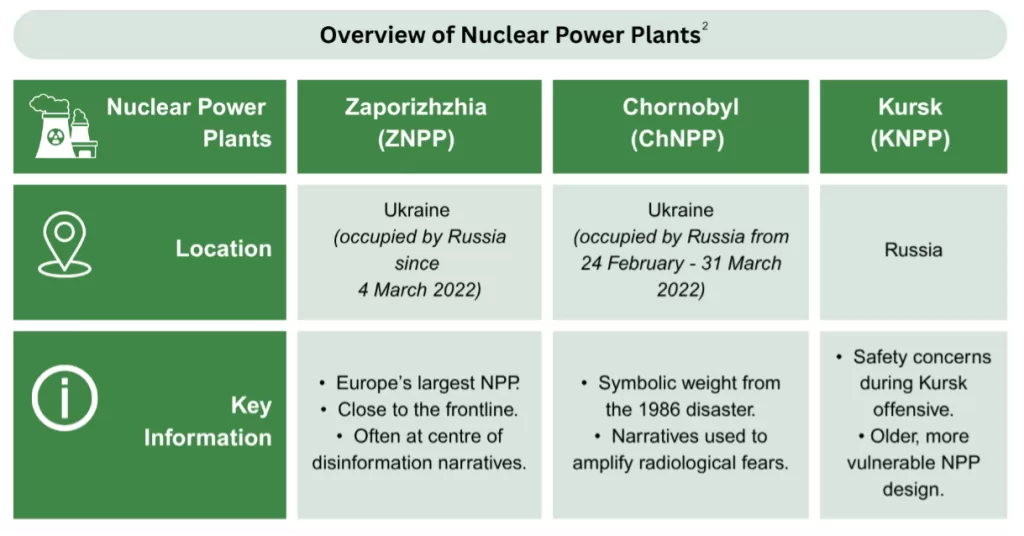
While ZNPP has been central to ongoing radiological and nuclear disinformation, ChNPP and KNPP have also featured in the information operation. References to ChNPP often tap into historical radiological anxieties,3 while military activities near KNPP are used to depict Ukraine as a threat to Russian nuclear security.4 Each site plays a distinct role: ZNPP as an occupied and compromised site, ChNPP as a symbol of past catastrophe, and KNPP as a vehicle for cross-border escalation narratives.
VERIFICATION CHALLENGES
STRATEGIC AIMS
Disinformation campaigns around NPPs, particularly ZNPP, appear to reflect a deliberate effort to exploit nuclear infrastructure for the following military, political, and psychological advantage:
- Justifying Military Presence:10 By framing control of ZNPP as a measure of nuclear risk management, occupation shifts from a violation of sovereignty to a promotion of nuclear safety.
- Delegitimising Ukraine’s Reputation:11 Narratives that cast Ukraine as incapable or reckless with nuclear infrastructure erode international confidence in its governance. 12
- Blurring Global Norms: Undermining of long-standing norms that civilian nuclear facilities should be excluded from military operations, a principle aimed at preserving their safety during conflict.
TACTIC COMPARISON
Despite differences in the narratives surrounding the ZNPP, ChNPP, and KNPP, consistent disinformation tactics are evident across all three cases. The most prominent techniques include:

Unsubstantiated Attribution
Attributing harm or negligence to deliberate adversary actions without substantiated evidence, to shape international perception.

Manipulating Content
Using altered imagery, selectively framed data, or misleading video to fabricate or distort evidence in support of false narratives.

Amplifying anxiety through alarmist rhetoric or exaggerated consequences to provoke panic and erode public trust in official information.

Disseminating large volumes of misleading or contradictory information across multiple channels to confuse audiences and crowd out accurate reporting.
The presence of these disinformation tactics across three diverse examples suggests they constitute a blueprint likely to be reused in future conflicts involving NPPs. Developing a nuanced understanding of this disinformation toolkit is essential for building resilience and ensuring effective crisis response.
CONCLUSION
Disinformation during conflict can threaten nuclear safety by distorting threats, provoking risky actions, and delaying response. It disrupts the ability of institutions like the IAEA to operate effectively and reveals gaps in global mechanisms meant to protect nuclear sites during conflict. ZNPP specifically demonstrates how these dynamics heighten the risk of escalation.
These NPP crises not only challenge Ukraine’s legitimacy but expose vulnerabilities in global nuclear governance frameworks.15 With disinformation increasing confusion and mistrust around nuclear facilities under occupation and within active war zones, institutions must adapt by strengthening safety measures, assessing protocols and implementing crisis communication strategies.
TIMELINE
24 February 2022
Russia launches full-scale invasion, occupies ChNPP.
4 March 2022
RRussia occupies ZNPP.
31 March 2022
Russian forces withdraw from ChNPP.
5 August 2022
Initial reports of shelling damage to infrastructure at ZNPP.
25 August 2022
First loss of off-site power at ZNPP. (Off-site power is lost nine times between Aug 2022 and Jul 2025).
23 November 2022
Nationwide blackout affects all Ukrainian NPPs.
6 June 2023
Kakhovka Dam collapses, impacting ZNPP’s cooling water reserves.
3 October 2023
Reports of drone attacks near KNPP.
11 August 2024
Fire damages ZNPP cooling tower after a drone attack.
14 February 2025
Drone strike hits ChNPP’s New Safe Confinement dome.
August 2025
READ MORE:
REFERENCES
- Helen Davidson, “State-backed Disinformation Fueling Anger in China Over Fukushima Water,” The Guardian, September 4, 2023, https://www.theguardian.com/environment/2023/sep/04/state-backed-disinformation-fuelling-anger-in-china-over-fukushima-wastewater-japan.
- Laurence Peter, ‘Ukraine War: Chernobyl Scarred by Russian Troops’ Damage and Looting’, BBC, 3 June 2022, https://www.bbc.com/news/world-europe-61685643; Disinformation Tactic Spotlight: Reference to Past Crises’, GP Countering WMD Disinformation Initiative, October 2024, https://gpwmdcounterdisinfo.com/policy-briefs/reference-to-past-crises/; Sergey Radchenko, ‘Fearing Russia’s Futures’, Engelsberg Ideas (blog), 23 February 2024, https://engelsbergideas.com/essays/fearing-russias-futures/.
- ‘Disinformation Tactic Spotlight: Reference to Past Crises’, GP Countering WMD Disinformation Initiative, October 2024, https://gpwmdcounterdisinfo.com/policy-briefs/reference-to-past-crises/; Sergey Radchenko, ‘Fearing Russia’s Futures’, Engelsberg Ideas (blog), 23 February 2024, https://engelsbergideas.com/essays/fearing-russias-futures/.
- Reuters, ‘Russia Intercepts Drone near Kursk, No Damage to Nuclear Plant, Governor Says’, Reuters, 3 October 2024, https://www.reuters.com/world/europe/russia-intercepts-drone-near-kursk-no-damage-nuclear-plant-governor-says-2024-10-03/; Darya Dolzikova, ‘Kursk Nuclear Power Plant: The Newest Target for Russian Disinformation’, RUSI, 28 March 2025, https://www.rusi.org/explore-our-research/publications/commentary/kursk-nuclear-power-plant-newest-target-russian-disinformation.
- International Atomic Energy Agency, ‘Timeline of the IAEA’s Response Activities to the Situation in Ukraine’, accessed 17 February 2025, https://www.iaea.org/interactive/timeline/169792.
- ‘Ukraine, Russia Blame Each Other for Shelling of Nuclear Plant’. Reuters, 11 August 2022, sec. Europe. https://www.reuters.com/world/europe/ukraine-energoatom-says-zaporizhzhia-nuclear-power-plant-shelled-again-2022-08-11/; ‘Drone Strikes Chornobyl Nuclear Plant in Ukraine, Russia Says Not to Blame’. Al Jazeera, 14 February 2025. International Atomic Energy Agency.
- International Atomic Energy Agency. ‘Update 274 – IAEA Director General Statement on Situation in Ukraine’. IAEA, 12 February 2025. https://www.iaea.org/newscenter/pressreleases/update-274-iaea-director-general-statement-on-situation-in-ukraine.
- ‘IAEA Postpones Mission Rotation to Nuclear Plant Due to Lack of Russian Guarantees, Kyiv Says’. 5 February 2025, sec. Europe. https://www.reuters.com/world/europe/iaea-postpones-rotation-mission-zaporizhzhia-plant-due-lack-security-guarantees-2025-02-05/.
- International Atomic Energy Agency. ‘Update 295 – IAEA Director General Statement on Situation in Ukraine’. IAEA, 5 June 2025. https://www.iaea.org/newscenter/pressreleases/update-295-iaea-director-general-statement-on-situation-in-ukraine.
- ‘Disinformation Tactic Spotlight: Framing Russia as a Savior’, GP Countering WMD Disinformation Initiative, January 2025, https://gpwmdcounterdisinfo.com/policy-briefs/tactic-spotlight-russia-as-savior/; Iuliia Hoban and Alex Rister, ‘Nuclear Anxiety as an Instrument of War: The Use of News Media to Shape and Respond to the Disinformation Campaign Surrounding the Zaporizhzhia Nuclear Power Plant’, Media, War & Conflict, 12 June 2024, 17506352241256575, https://doi.org/10.1177/17506352241256575.
- ‘Disinformation Tactic Spotlight: Portraying States and Organizations as Puppets’, GP Countering WMD Disinformation, January 2025, https://gpwmdcounterdisinfo.com/policy-briefs/tactic-spotlight-portraying-states-and-organizations-as-puppets/.
- Ministry of Foreign Affairs of the Russian Federation, ‘Statement by the Deputy Head of the Delegation of the Russian Federation at the Second Session of the Preparatory Committee for the 11th Review Conference of the Parties to the Treaty on the Non-Proliferation of Nuclear Weapons (Cluster I: Nuclear Disarmament), Geneva, 25 July, 2024’.
- American Nuclear Society. ‘American and European Nuclear Societies Issue Joint Statement Denouncing Attacks on Ukraine’s Nuclear Facilities and Misinformation’, 6 April 2022. https://www.ans.org/news/article-3823/american-and-european-nuclear-societies-issue-joint-statement/; Mark Wolverton. ‘Radiation Risks Are Real. But No Cause for Radiophobia.’ Bulletin of the Atomic Scientists, 16 September 2019. https://thebulletin.org/2019/09/radiation-risks-are-real-but-no-cause-for-radiophobia/.
- Miriam Matthews, ‘The Russian “Firehose of Falsehood” Propaganda Model’, RAND, July 2016, https://www.rand.org/pubs/perspectives/PE198.html
- Scott Roecker, ‘Nuclear Power Plants Under Attack: The Legacy of Zaporizhzhia’, Arms Control Association, April 2023, https://www.armscontrol.org/act/2023-04/features/nuclear-power-plants-under-attack-legacy-zaporizhzhia#bio.